All items can be
ordered at http://www.lulu.com
by following the clickable links.
Prices will vary over time
due to changing production costs and currency exchange
rates.
Lulu frequently offers discounts
through coupons. The hardback versions have been retired.
Marinus Anthony van der Sluijs
On the Origin of Myths in Catastrophic Experience
Creation myths around
the world reveal an intricate network of recurrent
motifs. Many of these are counterintuitive and
not widely known, describing a time when the sky
was low, the stars did not yet shine, multiple
suns appeared, the moon was brighter than the
sun, no land existed, deities and mortals maintained
frequent contact, a 'world axis' in the form of
a tree, ladder or giant man connected the earth
with the sky, a devastating flood or fire ended
the old order, and so forth.
The present work, in multiple volumes,
aims to find an origin for this cross-culturally
and internally consistent body of traditions in
a series of natural events relating especially
to the earth's transition from the last glacial
period to the Holocene.
The two volumes listed below are
now available. Read a summaryhere.
All remaining volumes have been completed in draft,
but their preparation for publication will unfortunately
require funding.
Please contact
me for further information.
This first volume sets the stage
for the interdisciplinary hypothesis. Essential
lines of research receive a historical introduction:
comparative mythology, catastrophism and the study
of the mythical world axis in relation to the
earth's rotation. Various astronomical and meteorological
interpretations that are not strictly catastrophist
are explored for several types of myths about
the sun, the moon and the world axis, but leave
many of the most intriguing traditions unexplained.
It is argued that a structural core of the worldwide
mythology of 'creation and destruction', in which
the cosmic axis takes pride of place, points to
a specific period of dramatic natural circumstances
in real prehistoric time. A new synopsis is provided
of this universal mythological substrate. It emerges
that the mythical world axis cannot have been
based on a single object seen or imagined at one
of the poles, as has usually been supposed. This
surprising conclusion paves the way for the innovative
geomagnetic theory proposed in volume 2.
paperback
ISBN 978-1-9994383-2-6
With a foreword by Professor Trevor Palmer
XXXV + 441 pages, including 117 illustrations and index
volume 2 The Earth's Aurora
(Vancouver: All-Round Publications, 2021)
In this second volume, the earth's
magnetic field and aurora take centre stage. Geomagnetic
reversals are rare occasions when the field dwindles,
the north and south magnetic poles trade places,
and minor poles come into play. This process remains
incomplete in the much more frequent case of a
geomagnetic excursion. Throughout history, people
have personified and mythologised the aurora.
If a geomagnetic excursion had occurred within
human memory, they could have observed spectacular
transformations of the lights, even at low latitudes,
and enshrined these in myths, monuments, images
and rituals. Many elements of the primordial condition
described worldwide may thus be explained - awe-inspiring
luminous rings, arcs and columns, often dynamic
and structured, that seemingly held up a gloomy,
low-hanging sky.
Evidence is cited for two excursions
that could have informed age-old traditions in
this way. Specialists dispute both and a way out
of the controversy is proposed. The unique effects
that a geomagnetic reversal or excursion must
have on the aurora are further explored through
possible contemporary parallels on other solar-system
bodies and in experimental work on terrellae,
of which a historical survey is given. A wealth
of new information is provided throughout on the
history of geomagnetic studies and auroral physics.
paperback
ISBN 978-1-9994383-3-3
With a foreword by Dr. C. J. Ransom
XXXIII + 516 pages, including 168 illustrations and index
Marinus Anthony van der Sluijs
Traditional Cosmology The Global Mythology
of Cosmic Creation and Destruction (London: All-Round Publications, 2011; Vancouver,
All-Round Publications, 2018)
This work, in 6 volumes, is a compendium of traditional
cosmologies worldwide. The material includes the
global mythology of creation and destruction,
but also comprises information drawn from other
areas of traditional knowledge, ritual, iconography,
shamanism, costume, and dance. Relying on original
sources, universal points of agreement are identified,
often of a counterintuitive character. These suggest
a single template, a blueprint for a universal
mythology of origins with local variations.
volume 1 Preliminaries; Formation (2011)
In volume 1, the cosmos
is seen to develop from an original state of chaos,
via the transitory stage of a fundamental enclosing
particle, into a 'sheet system' of sky, atmosphere,
earth and underworld, joined by the cosmic axis.
paperback
ISBN 978-0-9556655-3-0
285 pages, including index
volume 2 Functions (2011)
Volume 2 offers an analysis of
the basic properties of the cosmic axis. These
include its role in cosmic stability, support
and traffic; descriptions of the sky and the underworld
at its extremities; its encompassing, peripheral
or central geometry; its association with life;
and its luminosity.
paperback
ISBN 978-0-9556655-4-7
300 pages, including index
volume 3 Differentiation (2011)
In volume 3, the nascent cosmos
is seen to fragment in a variety of ways. Concentric
rings or windings, cardinal directions, and layered
heavens and underworlds develop around the cosmic
axis. The column or its extremities split into
two or three. And holes are formed at the intersection
of the column and the framework of the cosmos.
paperback
ISBN 978-0-9556655-5-4
328 pages, including index
volume 4 Disintegration (2011)
In volume 4, the cosmos is seen
to disintegrate through a number of catastrophic
events. The cosmic axis is disrupted. The regions
of the cosmos are freshly populated. Mythical
beings depart from the earth and the mythical
era is ended. The future is expected to bring
a repetition of the past events of creation and
destruction.
paperback
ISBN 978-0-9556655-6-1
379 pages, including index
volume 5 Solar and Lunar Anomalies (2018)
Volume 5 documents a large number
of traditions concerning unusual and often undesirable
properties and activities of the sun and moon.
To name just a few examples, prominent beliefs
were that the moon was originally brighter than
the sun and that the earth once succumbed to the
heat caused by the sun's former proximity, its
greater strength, its failure to move or the appearance
of multiple luminaries.
paperback
ISBN 978-1-9994383-0-2
335 pages, including index
volume 6 Miscellaneous Themes (2018)
Volume 6 offers a miscellany of
traditions. Salient examples are the beliefs that
the seasonal cycle was not always stable, that
the morning or evening star used to be a comet
or meteor, that objects or deities fell out of
the sky, that the earth once turned over or changed
places with the sky, that fossils are the remains
of former giants and that specific areas now under
water were originally dry land.
paperback
ISBN 978-1-9994383-1-9
196 pages, including index
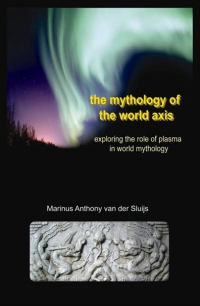
The Mythology of the World
Axis; Exploring the Role of Plasma in World Mythology
(London: All-Round Publications, 2007)
Towards the end of the universal
Stone Age, the sky was ablaze with awe-inspiring
forms not seen today. Dominant among these was
a towering, life-like pillar of light stretching
from near the horizon to high up into space -
the tree of life, the world mountain, the ladder
to heaven. This message is heard in virtually
every ancient society on earth, but while this
'world axis' is familiar enough to scholars, little
sense could be made of the stories. The most conspicuous
feature of the ancient cosmologies also remained
the most elusive.
From a modern scientific perspective,
such traditional accounts no longer sound preposterous.
Our growing knowledge of striking events in recent
earth history substantiates the possibility that
prehistoric people witnessed a prolonged display
of high-energy auroras. This colourful book is
an edited slideshow that was intended as an accessible
'appetiser' for the series listed above.
paperback
ISBN 978-0-9556655-0-9
91 pages
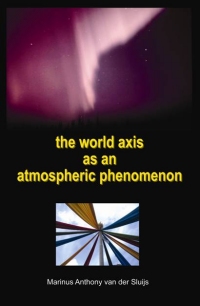
The
World Axis as an Atmospheric Phenomenon
(London: All-Round Publications, 2007)
Cultural anthropologists often use
the term axis mundi in a looser sense than
the strict astronomical one. This poses a problem,
because the objects they identify as ‘axis
mundi’ in mythological and early cosmological
sources do not correspond to the present state
of the axis of the earth. The association of these
objects with the axis of the earth does not appear
to have been made explicitly and unambiguously
before the 1st millennium BC, probably because
the rotation of the earth around its axis was
not commonly known in earlier times.
By contrast, the mythological
phenomenon loosely identified as the axis mundi
dates back to the earliest stages of civilisation
and is described by the most diverse cultures
in remarkably similar terms. It can be explained
by reference to a once visible entity in the sky,
with a complex, evolving morphology and a possible
link to the zenith or the pole. The prototype
may have been the zodiacal light or, as recent
insights in plasma physics indicate, an enhanced
aurora formed in prehistoric times.